The Expansion of Tutorial Resources Guiding Newcomers Through Blackjack Strategies on Regulated British Websites
Written by Rosa Vogel · Nov 12, 2026

The Expansion of Tutorial Resources Guiding Newcomers Through Blackjack Strategies on Regulated British Websites
Regulated British websites have expanded their tutorial resources for blackjack strategies, and this growth connects directly to increased demand from newcomers seeking structured guidance on gameplay fundamentals, probability calculations, and decision-making frameworks. Platforms now integrate interactive modules, video walkthroughs, and simulation tools that break down basic rules alongside advanced techniques such as card counting avoidance within legal boundaries and bankroll management protocols.
Growth Patterns in Educational Content Delivery
Data from industry monitoring groups shows that tutorial sections on these sites have grown by measurable margins since early 2025, with operators adding layered content that progresses from simple hit-or-stand choices to more complex topics like splitting pairs and doubling down under specific hand conditions. Observers note that developers have incorporated user feedback loops to refine explanations, and this approach allows players to test scenarios in risk-free environments before engaging with real stakes.
Research indicates that many newcomers start with short modules covering house edge calculations, and those sessions often lead into extended simulations where individuals practice against virtual dealers. Figures reveal that completion rates for these introductory sequences have climbed steadily, while follow-up materials on variance and session tracking attract repeat visits from the same users.
Core Strategies Highlighted Across Platforms
Tutorials typically organize content around standard strategy charts that map optimal moves for every possible dealer upcard and player total combination, and these charts appear in both static and interactive formats. Additional layers address common misconceptions about progressive betting systems, while clarifying that no method alters the underlying mathematical probabilities established by deck composition and payout structures.
Some resources dedicate segments to regional rule variations found on British-licensed sites, such as differences in blackjack payout ratios or surrender options, and users can toggle between rule sets to compare outcomes. Experts have observed that this comparative method helps newcomers understand why certain decisions yield better long-term results even when short-term variance creates misleading results.
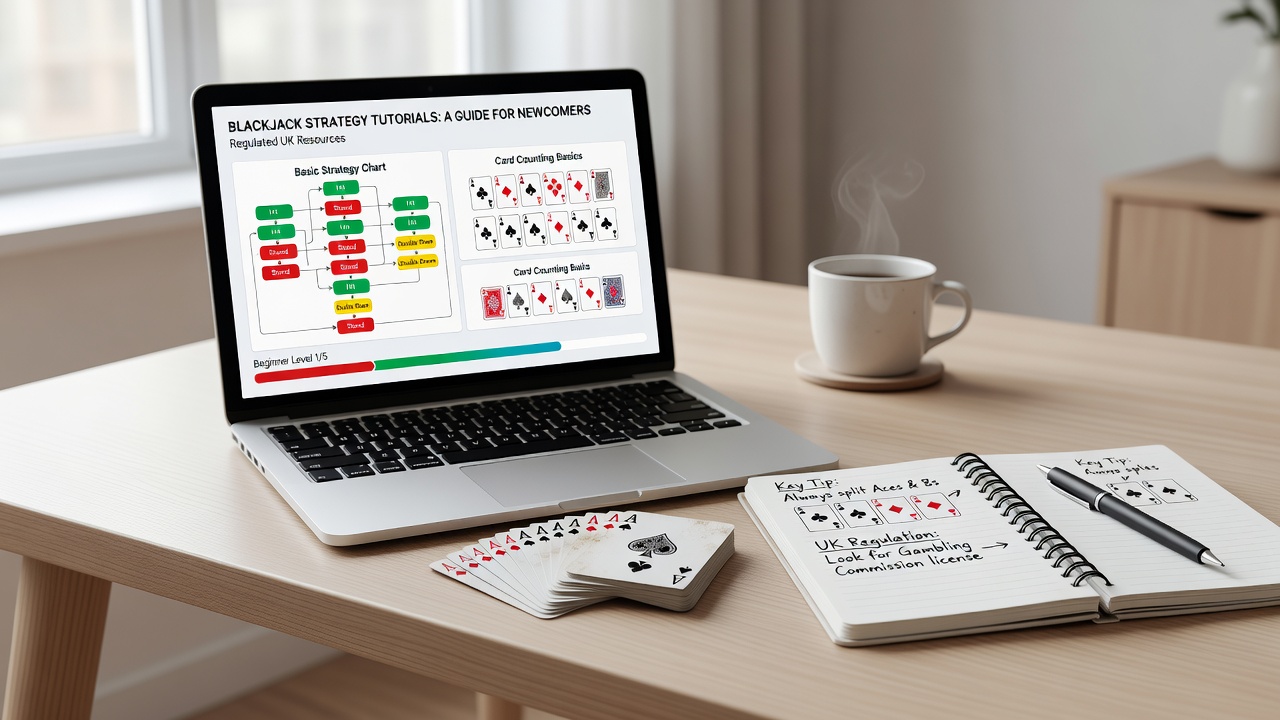
By November 2026, several sites had rolled out updated modules that incorporate real-time feedback during practice rounds, highlighting deviations from optimal play and explaining the expected value impact of each choice. Those enhancements build on earlier static guides by adding branching scenarios that mirror live table dynamics without requiring simultaneous play against other participants.
Integration With Platform Features and Compliance Standards
Operators align tutorial content with responsible gaming prompts that encourage setting deposit limits before strategy practice begins, and this integration appears in pop-up reminders during extended simulation sessions. Content creators draw from aggregated player behavior data to prioritize topics that generate frequent questions, such as insurance bet calculations and the long-term effects of deviating from basic strategy tables.
According to reports from the Canadian Gaming Association, similar educational expansions in other regulated markets have correlated with higher player retention when tutorials emphasize factual probability over guaranteed outcomes. British platforms have adapted comparable frameworks while tailoring examples to local game variants and device preferences.
Industry associations have documented how tutorial libraries now include accessibility options like adjustable text sizes and audio narration, and these features broaden reach to users who prefer non-visual learning paths. Data shows that multi-format delivery increases completion rates across demographic groups, particularly among those accessing content through mobile applications.
Emerging Trends Observed in Late 2026
Platform analytics from November 2026 indicate that strategy tutorial usage peaks during evening hours and on weekends, coinciding with higher overall site traffic periods. Developers have responded by scheduling live webinars that review recent rule changes across different operators, and these sessions often feature question-and-answer segments focused on practical application rather than theoretical discussion.
One study revealed that players who complete at least three sequential tutorial levels demonstrate greater consistency in applying basic strategy during subsequent real-money sessions. Researchers from European academic institutions have tracked these patterns through anonymized datasets, noting that structured education correlates with longer average session durations without corresponding increases in average bet sizes.
Conclusion
The expansion of tutorial resources on regulated British websites continues to evolve through iterative updates that reflect both technological capabilities and observed user engagement patterns. Content now spans foundational concepts to nuanced applications, supported by simulation environments and compliance-aligned prompts. External analyses from organizations such as the Australian Institute of Criminology provide comparative benchmarks that operators reference when refining their materials. This ongoing development maintains focus on delivering accurate, accessible information that supports informed participation within established regulatory parameters.